| |
Short biography
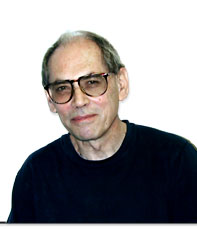
Composer and pianist Roger Smalley was born near Manchester, England, in 1943 and emigrated to Australia in the mid 1970s. His compositions, commissioned by prestigious organisations and groups - from the BBC and London Sinfonietta to the ABC and Australian Chamber Orchestra - have been performed and broadcast world-wide. His compositions and performances have been released on numerous CDs, and he has won awards both as composer and pianist: his own performance of his Piano Concerto was the recommended work in the UNESCO Composers' Rostrum in 1987.
Roger Smalley's career as an academic has been closedly tied to his activities as a composer and performer: his move from the UK to Australia was the result of a short composer residency at the University of Western Australia. After a significant academic career at the University of Western Australia, Roger Smalley now lives and works in Sydney.
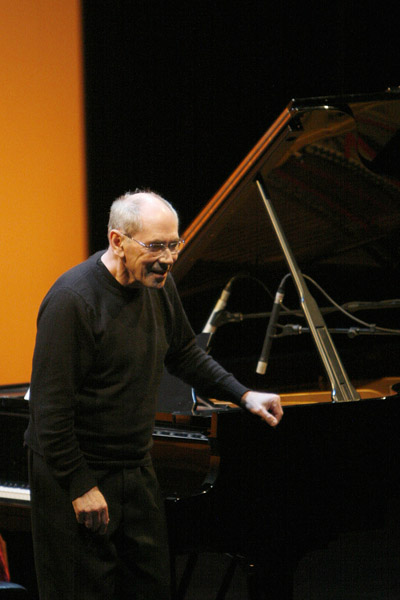
(Pictured: Roger Smalley after his performance at the Classical Music Awards Ceremony in Sydney, September 2007)
Biography
A prominent and versatile figure in contemporary music, Roger Smalley was born near Manchester, England in 1943. He studied piano with Antony Hopkins and composition with Peter Racine Fricker and John White at the Royal College of Music, London. He also took private composition lessons with Alexander Goehr and furthered his studies with Karlheinz Stockhausen on the Cologne Course for New Music.
Roger Smalley's compositions have been performed and broadcast world-wide. He has been commissioned by many prestigious organisations and groups, including the BBC, ABC, West German Radio, Festival of Perth, London Sinfonietta, Australian Chamber Orchestra, Fires of London, Flederman, Nova Ensemble, Seymour Group and Australia Ensemble. His works feature on more than 20 commercially released CDs.
As a young composer, he was awarded the Royal Philharmonic Society Prize for his orchestral work Gloria Tibi Trinitas. His Piano Concerto, a BBC commission for European Music Year (1985), was the recommended work in the annual UNESCO Rostrum of Composers in 1987. This was the first time the Australian Broadcasting Corporation's entry made it to the top of the list. In 2007, Smalley's orchestral piece Birthday Tango (recently retitled Footwork) received the Australian Classical Music Award in the category 'Best composition by an Australian composer'.
As a pianist, Roger Smalley is widely recognised for his performances of contemporary music. Early in his career, he was a prize-winner in the Gaudeamus competition for interpreters of contemporary music (1966), and received the Harriet Cohen award for contemporary music performance in 1968. In 1969, together with Tim Souster, he formed Intermodulation, an ensemble specialising in works involving improvisation and live electronics, which performed throughout England and Europe until 1976.
Smalley's academic career has always been closely tied to his activities as a composer and performer. In 1968, he was appointed the first Artist-in-Residence at King's College, Cambridge, where he subsequently held a three-year research fellowship. He came to Australia initially for a three-month composer residency at the University of Western Australia in 1974. He returned two years later to become a research fellow and subsequently Associate Professor of Music. In 1996, he was appointed a professiorial Research Fellow at the UWA.
Roger Smalley continues to perform a wide variety of solo and chamber music and also conducts. In 1989, he became the first Artistic Director and conductor of the West Australian Symphony Orchestra's 20th Century Ensemble, continuing until 2000. His recordings as pianist and conductor have been released, among others, on the ABC Classics and Tall Poppies labels.
In 1991 he was the recipient of a Creative Development Award from the West Australian Department for the Arts, and was elected a Fellow of the Australian Academy of the Humanities. In 1994 he was awarded the Australia Council's prestigious Don Banks Fellowship 'in recognition of his distinguished contribution to Australian music'. He received the Australian Government Centenary Medal in 2001 and was proclaimed a Western Australian Living Treasure in 2004.
Roger Smalley moved from Perth to Sydney in 2007. He is Emeritus Professor and Honorary Senior Research Fellow at The University of Western Australia and Honorary Research Associate at the Sydney Conservatorium of Music. In 2008, he continues to compose, perform and lecture and has written one of the two test pieces for the 2008 Sydney International Piano Competition.
(Updated: July 2008)
Curriculum vitae
Emeritus professor Roger Smalley
ARCM, MA.Cantab., D. Mus UWA, FAHA
26 July 1943 Born near Manchester, England.
1952 Began piano lessons.
1954 First compositions (Minuet in G, Romance in F, etc).
1954-61 Leigh Grammar School – 10 ‘O’ Levels (including Music) and
two ‘A’ levels (including Music).
1959-61 Northern School of Music – Junior Exhibitioner.
Piano with Dorothy Pilling.
1961 Won open scholarship to the Royal College of Music.
1961-1965 Royal College of Music, London.
Composition with Peter Racine Fricker and John White (also
privately with Alexander Goehr).
Piano with Antony Hopkins.
1964 Chappel Gold Medal (piano performance).
Associate of the Royal College of Music (teaching and
performing).
1965 Octavia Travelling Scholarship.
1965-66 Cologne Course for new Music (Rheinische Musikschule).
Composition with Karlheinz Stockhausen.
1966 Royal Philharmonic Society Prize (for orchestral work Gloria Tibi
Trinitas).
4th Prize Winner in the International Competition for Interpreters of
Contemporary Music (Gaudeamus, Utrecht).
1966-76 Active as a composer and pianist specialising in new music.
Many recitals and BBC recordings. Numerous first and first-UK
performances.
1967 - onwards
Many articles and reviews (the majority concerning 20th-century
music) published in the Musical Times, Tempo, Music and
Musicians, Proceedings of the Royal Musical Association, The
Times, The Times Educational Supplement, Australian Journal of
Music Education, Larousse Encyclopaedia of Music, etc.
1968 Appointed first Artist-in-Residence at Kings’ College, Cambridge
MA (Cantab).
The Song of the Highest Tower commissioned by and premiered
at the City of London Festival.
1968-69 Composed Transformation for piano with amplification and ring
modulation (first work involving live electronics).
1969 Formed Intermodulation (together with Tim Souster, Peter Britton
and Robin Thompson), an ensemble specialising in the realisation
of contemporary scores, particularly those involving live electronics.
Until early 1976, this ensemble played over 70 concerts in Britain,
West Germany, France, Poland and Iran, and made numerous
broadcasts for BBC, WDR, Radio Bremen and Hessischer
Rundfunk. The group plays on the DGG recording of Stockhausen’s Sternklang.
1969-72 Research Fellow of King’s College, Cambridge.
1971 Beat Music commissioned by the BBC and premiered at the Proms
by the London Sinfonietta and Intermodulation.
1972 Played Hammond Organ in the first complete performance, and
subsequent DGG recording, of Stockhausen’s Momente [‘Europa
Version’].
1973 Zeitebenen (for Intermodulation and 4-channel tape)
commissioned by the West German Radio. The tape was realised
in the electronic studio of the WDR and the first performance took
place in Düsseldorf as part of the Musik der Zeit series.
1974 At the invitation of Professor Sir Frank Callaway, visitor to the
University of Western Australia (UWA) as Musician-in-Residence.
Didgeridoo (for 4-channel tape) realised in the University’s
electronic studio.
1974-75 Accord for two pianos composed on return to England.
1976-78 Research Fellow, the University of Western Australia
Resident in Australia, Permanent Resident status.
1976 - present Active as a solo pianist, accompanist and chamber music player –
most notably as a founding member of the Australian Piano
Quartet. Distinguished artists he has accompanied include: Jane
Manning, Geoffrey Michaels, Alan Hacker, Linda Hirst, Gerald
English, Rohan de Saram, Artö Noras, Carmel Kaine, Florian Kitt,
Christian Lindberg.
1978 Chamber opera William Derrincourt written at the request of Sir
Frank Callaway and premiered at the Octagon Theatre (UWA),
produced by John Culshaw.
1980 Konzertstück for violin and orchestra commissioned by the
Festival of Perth and premièred by Ashley Arbuckle and the West
Australian Symphony Orchestra conducted by David Measham.
1981 Symphony commissioned by the BBC and premiered at the Proms
by the BBC Philharmonic Orchestra conducted by Sir Edward
Downes.
1983 Awarded D.Mus. (The University of Western Australia).
The Narrow Road to the Deep North commissioned and
premiered by The Fires of London.
1985 Soloist in premiere of Concerto for Piano and Orchestra,
commissioned by the BBC for European Music Year 1985.
Lectures and recitals at the Universities of Pennsylvania, Princeton
and and Swarthmore College.
1987 An Australian Broadcasting Corporation (ABC) recording of the
Concerto for Piano and Orchestra, competing with over 70 works
from 34 countries, received the top award (that of 'selected work')
at the Paris Rostrum of Composers (UNESCO). This recording has
subsequently been broadcast in at least 32 countries.
A CD of Piano Concerto and Symphony released by the ABC.
1988 Premiere of The Southland, a 50-minute oratorio for large forces
commissioned by the Australian Bicentennial Authority.
1989 American premiere of Piano Concerto in Buffalo, New York.
Appointed conductor and artistic director of the West Australian
Symphony Orchestra’s 20th Century Ensemble – positions he held
until 2006.
1990 Became an Australian citizen.
1991 Elected Fellow of the Australian Academy of the Humanities
(FAHA).
Premiere of Diptych (Homage to Brian Blanchflower) by the
WASO, conducted by Jorge Mester.
Recipient of a Creative Development Award from the West
Australian Department for the Arts.
1992 Associate Professor, the University of Western Australia.
Premiere of Poles Apart by the Australia Ensemble.
Release of CD Incredible Floridas (contains Ceremony II).
1994 Awarded the Australia Council’s Don Banks Fellowship for his
contribution to Australian music.
1996 Appointed Professorial Research Fellow at UWA.
2000 Commissioned by Sydney International Piano Competition of
Australia to write his Piano Concerto No 2 for performance by that
year’s winner.
2001 Recipient of Australian Government Centenary Medal.
Composer in Residence Barossa Arts Festival with Peter
Sculthorpe.
2003 Release of first all Smalley CD (Kaleidoscope, ABC Classics).
2004 Proclaimed a State Living Treasure by the West Australian
Government.
Perth International Arts Festival composer in Residence with
Magnus Lindberg (Finland).
Premiere of Piano Quintet with the Australian String Quartet at
Adelaide Festival.
Release of 2nd all Smalley CD (Poles Apart, NMC Recordings).
2007 Retiring from UWA, moved residence from Perth to Sydney.
Emeritus Professor and Honorary Senior Research Fellow at the
University of Western Australia.
Honorary Research Associate at Sydney Conservatorium of Music.
2008 Commissioned to compose one of the two test pieces for the 2008
Sydney International Piano Competition – majority of entrants
chose to perform Smalley’s work Morceau de Concours, including
all six finalists.
2009 Recorded performances by the Melbourne Symphony Orchestra of
Diptych (Homage to Brian Blanchflower) at the John Curtin
Gallery’s exhibition of art & music as part of the 2009 Perth
International Arts Festival.
Release of 3rd all Smalley CD (Melba Recordings).
Roger Smalley now lives in Sydney with his partner Pattie Benjamin. He has two
children (Rachel and David) and two grandchildren (Molly and Rosa).
A printable pdf version (20KB) of the CV.
Photographs
Photo screen resolution (206 KB)
Photo print resolution (599 KB)
|

|
|